Mechanisms
What makes a mechanical toy come alive is the ingenuity hidden inside it — cams, gears, levers and springs working in concert to produce lifelike motion from a simple motor or wound spring. This section documents the internal mechanisms of selected toys in the collection, with annotated photographs and detailed descriptions.
Clockwork
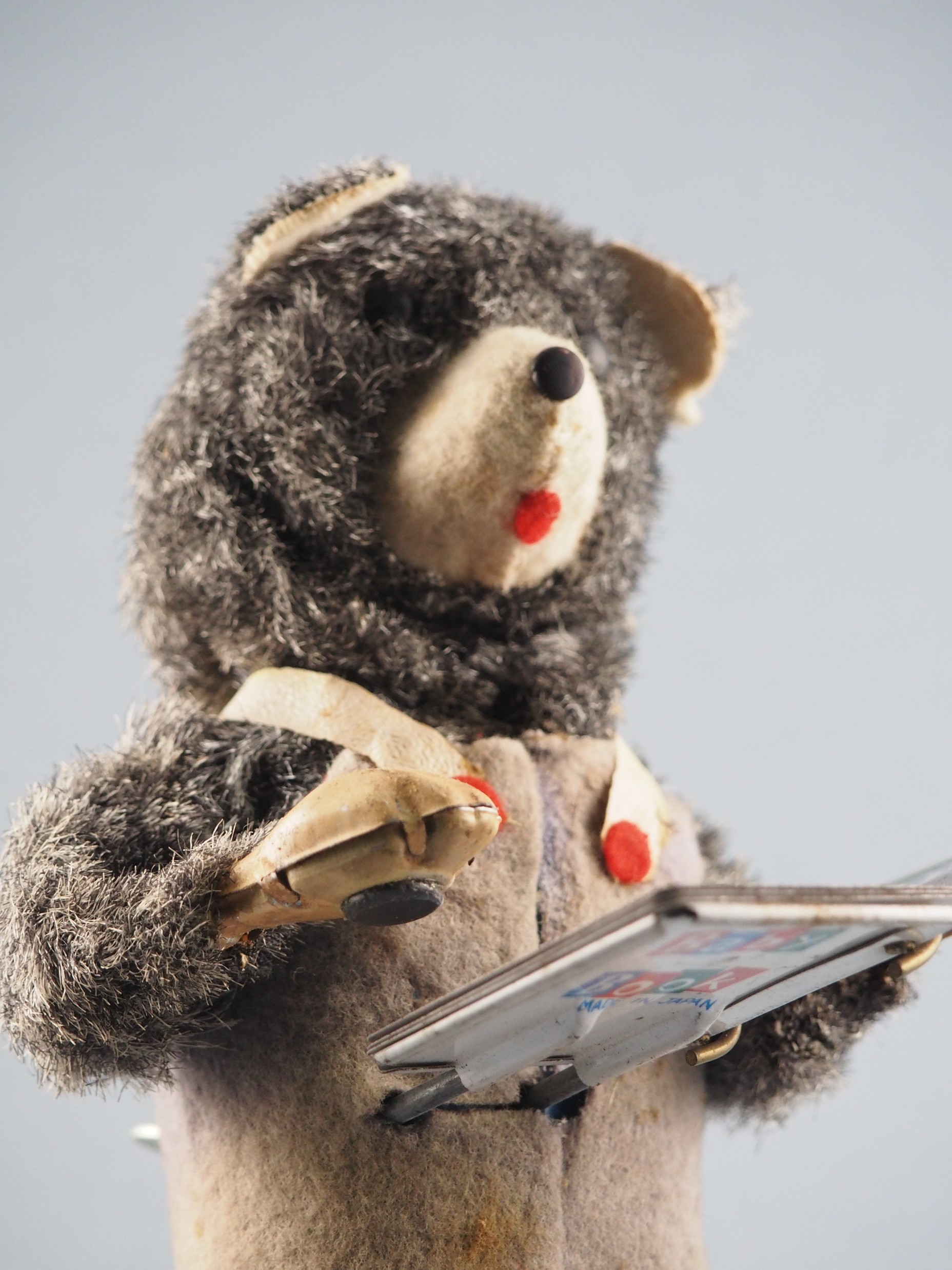
Reading Bear CUBY
Alps · 1955
Raises right arm and waves head by means of cams (similar to drinking toys, only faster); the metal pages change because the bear has a magnet in the right hand

Battery
V.I.P The Busy Boss
Susuki & Eduards · 1955
Bell (1) rings (a rotating double hammer hits a ledge on the side of the bell) during the time defined by cam (2), as this causes the hammers’rod to displace horizontally to the left. Simultaneously, a light goes on inside the telephone (wires (3)). Lever (4) raises rod (5), which causes left arm (6) to raise, rotate and raise further, and left arm (7) to lower. Now, lever (8) goes repeatedly down and up at a pace defined by the toothed cam (9). Since lever (8) is coupled to rod (10), it also makes the lower jaw (11) to open/close, and bellows (12) to blow air into a whistle (13). The rotation of the motor (14) pinion is transmitted to various shafts through gears. Shaft (15) transmits rotation to the hammers’ rod. The main shaft rotates due to gear (16). From left to right, it contains cam (17) which controls the displacement of lever 4, disk (18) with an insulating sector and in contact with copper tab (19), serving as switch of the telephone’s light (3), and cam (20), which controls the displacement of lever 8. The battery compartment is (21).

Battery
Telephone Bear Winky Eyes
Nomura · 1955
Motor (1) has 2 pinions on opposite sides, one transmitting movement to the gear mechanism (2), the other (3) contributing to the bear’s voice. Mechanism (2) powers the main shaft (4), which contains along its axis cams controlling the time during which the phone rings (5), the levers acting on the right arm (6), head (7), left arm (8), respectively, and the time during which the bear talks (9). Action starts with the phone ringing twice. This is achieved by means of cam (5) lowering two times lever (10) to which the vertical hammer (11) that hits the bell (12) is fixed. Then, lever (8) causes the left arm (13) to raise, rotate and raise further, due to the articulation (14). Now, the bear quickly moves head up and down due to the action of lever (7), while speaking. The sound is produced when cam (9) pushes a cardboard and paper ribbon (15) fixed to the bar (16) against pinion (3) in a vibrating mode caused by cam (17) raising/lowering the hook-shaped edge of the bar. Next, the left arm lowers/ rotates/ lowers back to the initial position, by action of lever (8) and articulation (13), and right arm (18) moves horizontally, as if writing, due to the action of lever (6) on articulation (19). Simultaneouly, the light (20) under the note pad goes on during a certain time to show the word “MAGIC”, as defined by the switch in cam (5).

Clockwork
Tyrolean with Alpine girl
Schuco · 1935
In this type of Schuco toys, the clockwork powered mechanism (1) rotates cam (2), which raises/lowers arms (3). The structure of the arms (3) consist of a single U-shaped wire with a V-shaped ledge in the base. Simultaneouly, rotation of the eccentric weight (4) causes the toy to vibrate and turn around

Clockwork
Solisto
Schuco · 1950
In this type of Schuco toys, the clockwork powered mechanism (1) rotates cam (2), which moves the right arm (3) holding the bow. The left arm (4) holding the violin is fixed. Simultaneouly, rotation of the eccentric weight (5) causes the toy to vibrate and turn around.

Battery
Wagon Master
Modern Toys · 1964
The batteries in box (1) power the motor (2). Hammers (3) hit the drum (5) sequentially at a rythm similar to that of horses galloping. Simultaneously and at the same sequence, lever (6) opens/closes the drum’s lid (7), thus creating two distinct sounds. Lever (4) causes the cowboy driver to move his body up and down.

Clockwork
Express-Boy
Gescha · 1938
Legs move as they are alternatively pushed by bars (1). Boy jumps onto the suitcase as arms rotate (2)

Battery
Piasecki Army Mule
Alps · 1965
The main shaft rotates due to gear (1). Its ends are connected by long springs (2,3) to the front and rear rotors, respectively. Gear (1) is part of a mechanism powered by motor (4). The rear whhel can be steered by means of a wire (5) connected to the remote control (6).

Battery
Apollo-11 American Eagle Lunar Module
Daishin · 1969
The toy uses 2 1.5V D batteries in compartment (1). When the switch (2) is slid to “ON”, the pinion (3) of the motor (4) quickly rotates, and the gear mechanism (5) powers the wheels (6). If the toy hits an obstacle, these will change direction and the toy continues to move. Simultaneously, the toy makes a “buzzing” sound as cam (7) pushes intermintently the flexible metal sheet (8) against the pinion (3), the antena rod (9) rotates driven by lever (10) and a light blinks (light bulb on the back of the orange disk (11)) as the copper tab makes contact with the metallic shaft (13), which is partially covered by a plastic insulator. Periodically, cam (14) moves lever (15) forward, so that the attached spring (16) opens hatch (17) and the astronaut appears. The hatch soon closes as lever (15) recedes, assited by a spring (not shown).

Clockwork
Jubilant Songbird
Kohler · 1955
Cam (1) controls the movements of head and tail. It acts on lever (2), which not only makes the head turn sideways and the beak to open/close, but also pushes up or down bar (3), which is attached to a “plug”, thus changing the tune in the whistle (4). Lever (3) is also connected to lever (5), which acts on the tail. The quick rotation of wheel (6) causes the reciprocating movement of bar (7) which is attached to a plug, creating the basic bird’s trill.

Other
Sport Trainer Mystery Shooting Gallery
Technofix · 1965
The pistol (1) is fixed to a bar (2), both being loosely supported by shaft (3), so that they can move freely in a vertical plan. The user aims at target (4) and shoots by pressing trigger (5). The spring/lock mechanism (6) quickly rotates bar (7) forward, and rod (8), which is connnected to it, shifts to the left. In turn, rod (8) hits bar (9), causing needle (10) to punch the target from behind.

Clockwork
Quacking Baby Ducks
Cam (1) controls the movements of the necks/heads, beak opening/closing and quacking sound. Upon its rotation, cam (1) creates a reciprocating movement of bar (2) (an identical bar for the other head is in the back), which is connected to bars (3), causing neckas/heads to move forward/backward and beaks to open/close. Also, upon its rotation, the serrated face of cam (2) will cause the vibration of reed (4), the sound created being amplified by box (5).

Battery
Elektro-Construction Tow Truck
Schuco · 1955
The steering wheel of the remote-control acts on the vertical rod (1), which transmits rotation to shaft (2) by the spring drive belt (3) that sits on wheel (4) (rod (1) contains a similar but smaller wheel). Shaft (2) also contains at the lower edge a gear (5) that acts on the driving system of the front wheels (6). The horn is actuated by pressing (7), which releases the quick rotation of hammer (8) - powered by a dedicated clockwork mechanism (9) - which strikes bell (10). Motor (11) drives the truck, or the tow hook. (12) is an hand-break.

Clockwork
Bussing tow truck with bussing bus
Arnold · 1940
To prepare the toy to play, wind the clockwork spring (1), activate the break lever (2) and assure that lever (3) is down. Then, hook the tow bar (5) into slot (4). Slide the truck inside the bus until hearing a click. The tip of lever (3) should be inside slot (6), and bars (7) and (8) should be recoiled. To play the toy, move lever (9). Then, bar (8) will de-activate the break lever (2) pulling it down, so truck and bus will start moving together. Eventually, lever (3) will move up and out of slot (6), un-coupling the truck from the bus. Due to a spring attached to it, bar (7) will push the truck out of the bus, while the tow bar (5) slides progressively to the front. The truck will move towing the bus until stopping